Preface
“To transcend the image and grasp the essence at its centre.”— Sikong Tu, The Twenty-Four Modes of Poetry, Tang dynasty
To penetrate and transcend the outward appearance of things, and to integrate one’s personal insight into an eternal, complete and life-filled universe, has long been an important spiritual dimension in Chinese poetry, painting, calligraphy, music, literature and garden design.
The evolution of Western modern art at the beginning of the twentieth century first involved a departure from the imitation of the external appearance of natural objects. As Wassily Kandinsky observed: “An artist should pay no heed to so-called ‘comprehensible’ or ‘incomprehensible’ forms … his eyes must turn inward to his inner life, and his ears must listen to the voice of inner necessity.”
Before and after the Second World War, abstract art once dominated artistic thought and practice across Europe and America. Artists transformed the intangible rhythms of the inner spirit into colours, symbols and cadences charged with vital tension, while idealistic reflection was sublimated into cool forms of expression and ordered composition. In its pursuit of spiritual freedom and liberation, abstract art thus became one of the world’s most powerful and widely embraced modes of artistic expression for the assertion of individuality.
On the ancient soil of China, artistic creation that emphasises spiritual transcendence has likewise long contained a strong abstract dimension. As Chinese abstract artists continued to explore and realise their artistic ideals throughout the twentieth and twenty-first centuries, the richness and profundity of Chinese culture quietly unfolded through their acute perception and distinctive temperament, revealing scene after scene of creative wonder across the broad white surface of the canvas.
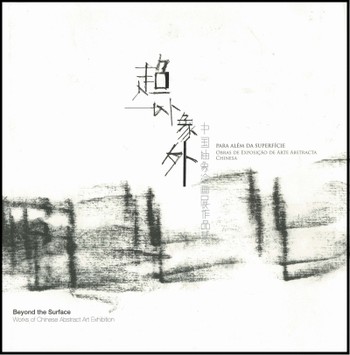
With great enthusiasm, the Macao Museum of Art has organised “Beyond the Image — A Collection of Chinese Abstract Paintings”, a major event bringing together artists from both sides of the Strait as well as Hong Kong and Macao. We believe this activity, transcending regional boundaries, will help usher in a springtime for the contemporary Chinese abstract movement. After two rounds of careful judging, we selected forty-two outstanding works for exhibition from nearly five hundred submissions, including five prize-winning works.
Self-discovery is the monologue of abstract artists in an age of heightened self-awareness. They choose to distance themselves from the memories and recognitions of worldly vision, allowing only their deepest thoughts, intuitions and emotions to be revealed before the canvas. For viewers, however, it is through experiences that resist language and defy fixed method that they hear the call of the contemporary human spirit; and in continually moving beyond the habitual constraints formed by accumulated convention, they alter and enrich their original perceptions, and come to recognise the profound power of “art for art’s sake”.
吳衛鳴 - Ng Wai-ming