Ten Artists Bring Creativity to the Kwun Tong Waterfront
By Hung Chit, text and photos
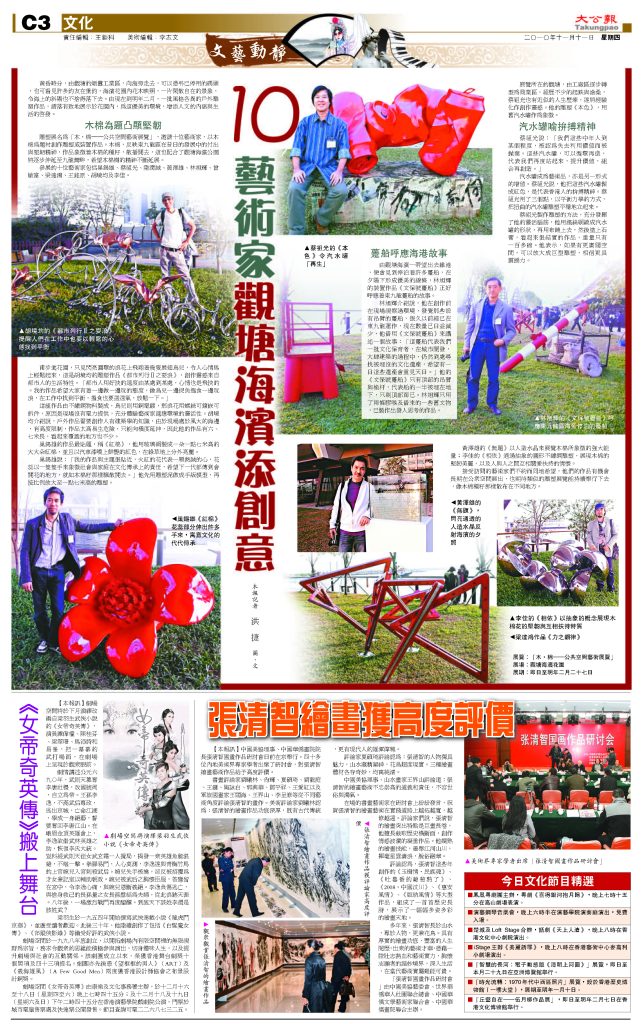
Photo caption: Choi Cho Kwong’s True Colours gives discarded soft drink cans a new life.
At dusk, leaving behind the clamour of Kwun Tong’s industrial district and walking towards the waterfront, one may reflect on the disused pier and watch anglers fishing by the shore. In the promenade garden, flowers and trees glow in the evening light, creating an atmosphere of ease and leisure, as though even the setting sun over the harbour is reluctant to disappear. From now until February next year, a group of outdoor sculptures in a variety of styles is being displayed throughout the garden, adding humanistic depth and inspiration to this beautiful setting.
Kapok as a Theme to Highlight Resilience
The sculpture exhibition, entitled Wood · Kapok — Public Space Art Exhibition, has invited ten artists to create sculptures or installation works based on the kapok tree. The kapok reflects the contribution and resilient spirit that characterised the development of East Kowloon in earlier years. The works symbolise kapok seeds dispersing into the distance, echoing the gradual extension of the Kwun Tong Waterfront Promenade towards Kowloon Bay, with the hope that the spirit of the kapok will continue to spread.
The ten participating artists are Chiu Sik-hung, Choi Cho Kwong, Luk Yun-shing, Wong Chak-hung, Lam Yuk-fai, Tsang Man-fu, Leung Tat-hung, Wong Ming-yuen, Wu King-kwan and Lee Kai.
Upon entering the garden, one is immediately greeted by several birds with outstretched wings soaring above sparkling circular waves, instantly lifting the mood. This is Wu King-kwan’s sculpture Urban Row II: Playing with the Waves, inspired by the way urban people live.
“City people move quickly from one place to another, and their moods move just as fast,” Wu explains. “My work hopes to encourage an attitude of working while playing, like birds catching fish for food while also playing in the waves. We need to find balance in our work; even while making a living, we should take time to breathe and relax.”
This group of works is made of stainless steel, while the birds are electroplated in bronze. The waves are assembled with screws so that they can be fitted together and dismantled, a practical response to the fact that there is no electricity available on site, demonstrating the artist’s flexibility in adapting to the environment. Wu notes that outdoor works require the maker to have architectural knowledge. Since the site is a windy seafront location with height restrictions, works that are too tall could be dangerous and therefore must extend horizontally instead. As a result, his work stretches six to seven metres in length and covers a considerable area.
Chiu Sik-hung’s work is perhaps the most directly related to the theme. Titled Red Kapok, it is a large kapok blossom made of fibreglass, standing 1.7 metres high and sprayed with vivid red automotive paint, making it especially striking against the green lawn.
Chiu says, “My work is closely connected to the theme. The fiery red flower represents a passionate heart, while the stamens, shaped as hands, symbolise the responsibility of society and the family in passing on culture. I hope the next generation can carry it forward to places where it will flourish, just as kapok seeds drift and spread.” He first modelled the sculpture in clay, then enlarged it proportionally into a 1.7-metre-high work.
A Barge in Dialogue with the Harbour’s Stories
Looking out over Victoria Harbour from the Kwun Tong waterfront, one can see many barges moored in the water, forming elegant lines beneath the setting sun. Lam Yuk-fai’s installation The Heritage Conservation Barge responds directly to the story of East Kowloon’s barges.
Lam explains that before beginning the work, he surveyed the site and realised that crane barges had been operating in East Kowloon for a very long time, though their numbers have been steadily declining. Through The Heritage Conservation Barge, he tells a story: “This barge represents a group of us who are committed to cultural conservation. Amid urban development and large-scale construction, we continue searching everywhere for buried cultural heritage, hoping that one day these lost traces will come to light again.” His Heritage Conservation Barge consists only of the crane and mast at the top, suggesting that half the vessel is buried underground, with only its upper structure remaining visible. Using only two plastic tubes and some borrowed old artefacts, Lam has created a work that invites reflection.
Kwun Tong, where the exhibition is held, has gradually transformed from an industrial area into a commercial district, and in the process has experienced many ups and downs. Choi Cho Kwong has undergone similar trials in his own life, and he has turned these experiences into creative inspiration. His sculpture True Colours uses old soft drink cans as its symbol.
Soft Drink Cans as a Metaphor for the Spirit of Perseverance
Choi says, “When people of our middle age reach a certain stage, they are often seen as having lost their usefulness and are discarded. But these soft drink cans can be recycled, representing our ability to rise again, regain value, and be reassembled into new creations.”
By becoming works of art, the cans also gain value in another sense. Choi explains that he painted them red to represent the fighting spirit of Hong Kong people. Using a three-point balance structure, he enabled the distorted can sculptures to stand steadily upright through the principles of equilibrium.
Choi’s method of making sculpture fully demonstrates his inventive and adaptable mind. He first shaped the form of the cans using wire mesh, then covered them with cloth before applying plaster. Although the finished work appears solid and substantial, it weighs only a little over one hundred pounds. He notes that, given a larger space, the piece could be enlarged into a monumental sculpture, which would be even more visually powerful.
Wong Chak-hung’s Untitled uses artificial crystal to express the powerful energy symbolised by the kapok, while Lee Kai’s Mutual Dependence, through an abstract circular stainless steel sculpture, presents the kapok’s resilient beauty as well as the spirit of mutual care and support between people.
The artists interviewed all expressed the shared hope that their works might have the opportunity to remain on long-term display in public spaces, and that similar sculpture exhibitions could continue to be held, spreading to different places like kapok seeds carried by the wind.