20 June 2018 | Source: Art Hong Kong | Author: Hau Siu-ching
Hong Kong's art scene is a crucible of artistic talent, where treasures are refined and hidden masters abound.
One senior painter known to the author, Choi Cho Kwong, is a particularly typical example. Readers may still remember that, at the 2005 Hong Kong Art Biennial Exhibition, a large abstract oil painting that viewers could physically rotate on the wall and appreciate from different angles opened many eyes. What was remarkable about this single work was that, as a two-dimensional spatial artwork, it allowed viewers to alter its visual effect instantly, breaking away from the conventional mode of static appreciation associated with easel painting. The artist of that abstract oil painting was Choi Cho Kwong.
Recently, Choi Cho Kwong's exhibition 'Ink Resonance · Sensation' Anatta 2018 was held at the Hong Kong Visual Arts Centre. "Anatta" is Mr Choi's sobriquet. Throughout history, painters have had, besides their surname, personal name and courtesy name, an additional hao — a fixed alias or art name. An artist's hao is often unrelated to his actual name and instead reflects his aspirations, character or philosophical outlook. From the two characters that make up Choi's sobriquet, "Anatta", the author already senses the philosophical realm embodied in this painter's thinking.
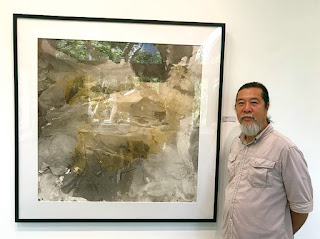
Choi told the author that his paintings do not admit of a single fixed interpretation. Like a magic performance, if everything were explained too clearly, the mystery would be lost, and with it the meaning of appreciation. He also said that his works are presented before the viewer so that each person may sense the transformations within the image for themselves, allowing the picture to guide thought and memory in search of familiar impressions and scenes from the past, leaving each viewer to “experience and understand in their own way”.
In this exhibition, Choi used the name “Anatta” to present a new series of ink works from his Impression Landscape body of work, completed between 2015 and 2018. Employing techniques such as shifting luminosity, rhythmic ink movement and richly textured vitality, these paintings express impressions from his inner world in abstract form, while also incorporating expressive elements associated with Western painting. In terms of materials, the artist has forged a new path by painting on smooth card rather than xuan paper, breaking with the tradition of using only xuan paper for ink painting. By adding a glossy varnish, the works take on an effect like molten gold. Ink traces spray, surge and billow, with subtle flowing variations. The overall use of gold, silver, black, white and grey draws on thought-images of mountains, rocks, water, earth, clouds and waves. This is precisely “acting in selflessness”, producing an ethereal sensation of colour that is almost beyond colour. Especially innovative, these new ink works possess natural atmosphere and distinctive interest, leaving the viewer dazzled and struck by their visual force.
Choi Cho Kwong's life has been full of dramatic turns and extraordinary trials. These experiences have given him a deep understanding of heaven and earth, the universe and the human world, elevating his reflections to a philosophical level and allowing him to arrive at theoretical conclusions. His abstract ink paintings are a full embodiment of this deeply personal mode of thought, which is why the artistic realm expressed in his works is so profound and capable of stirring boundless associations in the viewer.
In the author,s view, aesthetics is a crucial element in visual art. Some people, in their treatment of abstract painting, habitually adopt a “form for form's sake” approach, allowing form to determine everything. This concept has exerted a deep influence in the field of abstract painting. Yet abstract painting, no less than representational painting, is not abstract in its conception and composition. Mr Choi told me that, among the visitors to this exhibition, two women pointed at the paintings and muttered, “Anyone could do that — it's just random splashing.” Hearing such helplessly prejudiced remarks nearly made him laugh aloud. In truth, prejudice is farther from truth than ignorance. The only understandable thing is that they do not realise this kind of painting resembles the flexibility of tai chi, placing great emphasis on transformative imagery and methods of change grounded in philosophy. Indeed, if one looks at The Art of War by Sun Tzu — its principles of division and union, the orthodox and the unorthodox, the formless and the tangible, the empty and the solid — one could say they achieve the profound realm of moving from “formlessness to form” and then from “form to formlessness”. This is one of the basic laws of abstract painting, leaving viewers free to interpret it for themselves. It is then that one may begin to understand why Choi has chosen “Anatta” as his sobriquet.
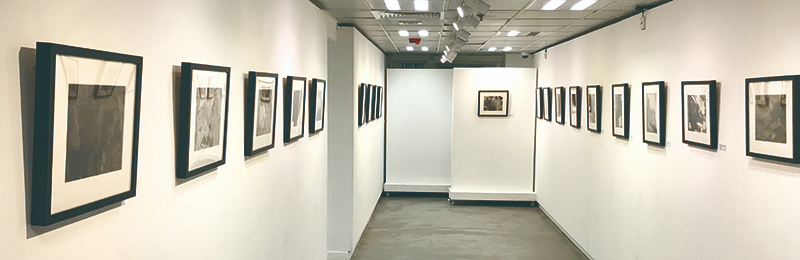
Choi's paintings are delicate and richly layered in content. On close study, the author finds that from “intention” to “image”, and then to overall structure, arrangement and compositional momentum, everything is filled with contemplation that moves from the realm of the “self” to that of “selflessness”. Beginning from artistic conception, the inner core of resonance and vitality runs consistently through the whole image. He resolves relationships between spirit and form, energy and image, union and division, the unusual and the orthodox, gathering and dispersal, openness and density, refinement and abbreviation, omission and selection, substance and emptiness, concealment and revelation, complexity and simplicity, black and white, and so on. Every aspect is handled with deep thought and care. There is neither formalist nor naturalist tendency, making clear the painstaking effort the artist has devoted to shaping pictorial effect and fully demonstrating his painterly skill and cultivation.
As I appreciated this group of abstract ink works in Choi's exhibition, I naturally thought of Liu Xie's discussion of the “origin of the Dao” in The Literary Mind and the Carving of Dragons, as well as Wang Wei's theories of ink landscape painting infused with Chan Buddhist thought. “To embody the nature of the natural world and accomplish the work of creation” — this makes one admire all the more how, after many years of arduous exploration and struggle, Choi Cho Kwong has steadily, step by step, forged his own path in abstract ink creation, and will continue to explore it with perseverance and bring it to further fruition. Through action, Choi puts into practice Qu Yuan's famous line: “The road ahead is long and has no ending; yet high and low I shall search with my will unbending.” The author looks forward to seeing even more and better works by Mr Choi in the future.
June 2018
Written at the Hong Kong Jockey Club Creative Arts Centre